
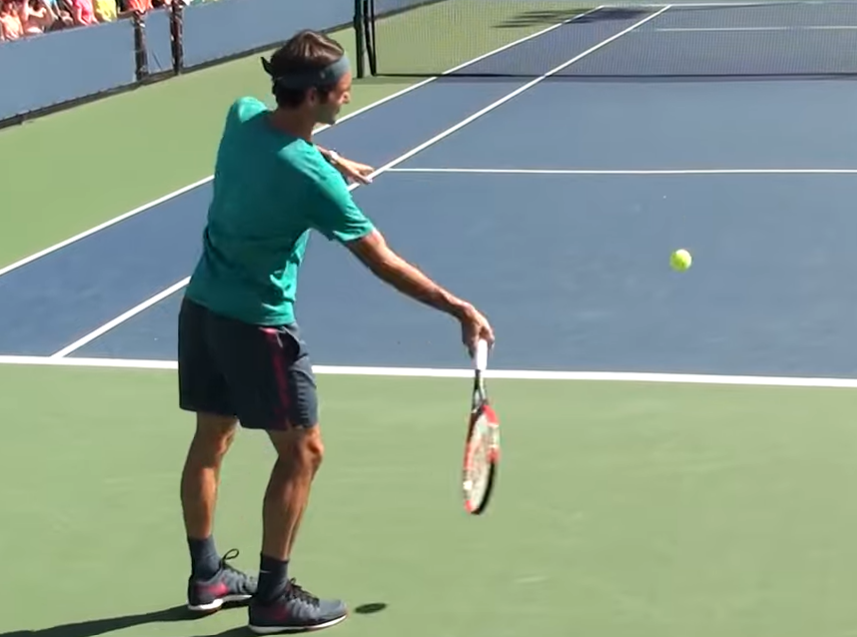
Every elite player has elite footwork. Every elite stroke is preceded by elite footwork, and non-elite strokes are almost always preceded by equally non-elite footwork. Ergo, good footwork causes good ball-striking, right?
Not quite.
When A and B are tightly correlated, there exist three options for causality, not one:
- A causes B
- B causes A
- some third factor, Z, causes both A and B
Even when observing a very tight correlation, we don’t know which way the causality flows without further evidence. In tennis, we observe a very tight correlation between elite footwork and elite ball-striking, which means that one of the following is true:
- Elite footwork causes elite ball-striking.
- Elite ball-striking causes elite footwork.
- Some third factor causes both elite footwork and elite ball-striking.
Most assume it’s #1, but the truth is closer to #2 – elite ball-striking causes elite footwork. The players with the best understanding of their striking action demonstrate the best footwork, because intent to strike the ball is what organizes the feet.
Don’t Believe Me? Watch This.
Roger Federer’s footwork for the first 2 minutes of this practice session is “awful” by any objective metric. He’s essentially walking, moves in a high stance instead of low and wide, and he routinely hits with his feet together. He barely recovers after he hits, barely gets set before his opponent hits, then takes a half-hearted split-step and walks to the ball again.
And yet he never misses a shot.
The above video is a refutation that clean ball-striking requires elite footwork. It does not. As seen above, quality striking is possible while, quite literally, walking around the court. Each of Roger Federer’s strikes during these 2 minutes was essentially perfect, despite the “bad” footwork. They were centered, well-timed, and trivially in.
We will explain footwork’s role in faster-paced tennis later, but before we get there, we need to explain exactly how the footwork-striking causality is flipped from what’s usually understood. For now, really internalize the surprising nature of the video above. If it were, in fact, the elastic hopping, quick adjustment steps, and lateral cuts that caused great ball-striking, the above performance would be impossible.
Physical Reality vs Your Motor Plan
In physical reality, footwork is causally upstream of contact. If your feet don’t get you into the right place, the swing that comes after suffers, and your contact will usually fail.
Physically, your footwork causes your contact.
Each individual forehand swing itself, though, doesn’t really matter. Your forehand isn’t a swing, but rather a function – a neurological pattern that takes in sensory input, and outputs a set of motor commands. In your forehand function, footwork is causally downstream of contact. Your plan to create a certain kind of contact causes your plan for a certain kind of movement. The neurological causal chain runs in the opposite direction as the physical causal chain.
Mentally, your desired contact causes your footwork.
Prerequisites for Footwork
The job of your feet is to space the ball, to orient your body so that the ball is in the perfect spot for you to strike it. This means that, at minimum, there are two skills you must have before footwork is even a coherent concept.
First, you have to know what perfect spacing is. You need to understand your hand, wrist, arm, shoulder – your entire personal kinetic chain – well enough that you actually know, visually, what perfect spacing looks like. If you don’t know what you’re trying to set up, how are your feet going to set it up for you?
Second, you have to track the ball. The feet never work by themselves – they are always intricately connected to the eyes. You never take a step that isn’t caused by what you’re looking at. If you’re not following the ball, not attentively tracking it from your opponent’s racket, through the ground, and onto yours, then any movement by your feet is purposeless.
To Fix Your Feet, Fix Your Striking Program
Many forehand misses that are physically caused by poor footwork are not best fixed by addressing the feet directly. Usually, it’s one of the two above skills that’s deficient – contact planning or visual tracking. That deficiency caused the feet to move incorrectly, and the swing broke. If a player doesn’t know what spacing they’re trying to create, their feet obviously aren’t going to create it, and if they aren’t seeing the ball, the feet’s movements, whatever their goal, are essentially random.
This is why I put “awful” in quotes when describing Federer’s footwork above. Even though he was basically walking, each of those walking steps was intentional, connected to his eyes, and together they successfully set up the strikes he was trying to create. The “footwork” skill demonstrated had nothing to do with the lower body itself – anyone can walk. It was Roger Federer’s elite ball-striking program that commanded a few casual walking steps in perfect service to his strikes.
What Elite Footwork Actually Enables
Elastic split-steps, quick balanced adjustment steps, and explosive lateral cuts enable proper spacing against higher quality balls. They do not create good ball-striking themselves, they maintain good ball-striking as conditions get more and more difficult. Not only that, but the harder you want to swing, the more perfect your spacing needs to be. If you’re a little off, but trying to hit slowly, you can just lean, or adjust with your arm. If you want to crack the ball, though – if you want to use your entire kinetic chain for racket-head speed, rather than adjustment – then spacing has to be perfect, and you’ll need more than walking steps to set that up.
Roger Federer’s deep, visceral, automatic understanding of contact is what commands his body to hop, step, and move, and as a result, the moment he decides to hit harder, his footwork pattern changes. The legs get wider, the body lower, the steps quicker. Command your forehand to produce a higher-quality ball, under more time pressure, and it’ll quickly figure out that balance and foot speed are necessary ingredients.


February 23, 2026
Back to back gems! I agree especially with the last part. Playing better players forces you to have better footwork by default. I have three questions.
1. How does one figure out the limiting reagents for their development? What is a sign that a misunderstanding of perfect spacing is the issue vs. ball tracking ability? My understanding is that I intuitively know my perfect spacing because when I really want to crack it, I adjust until I see the ball in its perfect position and then I release. So, for me, I think it’s a ball tracking issue usually. Now, I understand that we decouple executive function from vision. I remember you talking about Nadal’s practice shanks because he focuses more on mechanics and less on tracking, opposite the case in matches. I have gone into my matches now focusing on presence and maintaining sole attention on the current point and play and shot. When I do that, my UTR and shot making ability seems to jump like 3 points. It’s night and day. So, now I’m thinking vision was never my problem. I can count on my hand the times I have organically broken my strings, I hardly miss the sweet spot. I credit that to playing squash and badminton as a kid. But, I guess a second question to this is, what are questions I can ask myself with regards to ball tracking that can determine if its attentional or visual deficits that impair tracking and thus a worser contact?
2. What is contact planning really? I think one thing that precedes contact planning is aiming. You have to have some intentionality to where your shot wants to go upstream of your awareness of contact to create the start of your forehand function. My question is how deeply processed is this to the point where it doesn’t hamper your executive function. Is thinking about this even worth it? My understanding is say Djokovic wants to hit a backhand. How deep is his aiming of his shot to start? He’s receiving the ball, and somewhere while he’s receiving, he elects to hit a backhand cross court because his brain perceives down the line as too risky. So, now as he decides cross court, how fine tuned is his awareness of where he wants the ball to go? I remember your article on margins and making your own luck and thinking to myself, not once, when I am playing well, have I ever thought about the lines or depth, it just happens. I think, not even think “vague awareness”, in general directions and when I am more focused I tend to then naturally adjust to keep the ball in. If my brain lights up and thinks oooh approach shot, I sail it long. But when it’s all emergency attentional squash mode, my aiming is intrinsic and I am keeping it in with the correct adjustment if needed. In terms of implications of improvement, then I think you just got to get better using your racket in practice and then fight to maintain focus and attention and emergency in matches and trust your skills as that will set up your aiming, adjustments, and contact.
3. At what point are you just not fast enough, athletic enough, and conditioned enough, and how would you know? I think great athleticism and conditioning serves two purposes.
1. It lets you do more shit. Your brain I think naturally opens more doors for shots and speeds if it knows you can handle. Alcaraz’s brain lets him know he can hit that hard off a smash from Arthur Fils in Doha final match point(crazy shot you should see it) because he’s physically capable.
2. It is far easier to maintain high focus and executive function if your muscles are strong enough and you are conditioned enough that adequate blood flow is reaching your brain for processing.
Sorry for high word count. I hope that these questions can answer questions that others have. THANK YOU for your time and insight.
February 23, 2026
The answer is – it got too long for a single post. One great test, which will be discussed in a follow-up, is the Federer test: Can you walk around the court and trivially make 20 balls in a row while still using your elastic mechanics, not just pushing the ball. If you can, your striking understanding is pretty good, and if you’re failing at high speeds, working on the lower body specifically is a good idea. If you can’t, working on your feet might marginally help, but there’s something upstream that’s broken.
By contact planning, I mean a general awareness of where the ball is going to end up, where you need to be in order to strike it comfortably, and how you’re going to get there. The earlier that plan comes into view, the better. The program you run is still feed-forward – it updates as you move and continue watching the ball – but so often I see students who look like they’re on frame delay out there, where they almost freeze for a moment after their opponent hits before they’re able to start trying to receive the ball.
March 24, 2026
Johnny, I played two singles matches yesterday on a fast, slightly wet synthetic grass court. My main focus (especially on return of serve) was to watch my opponent’s contact and then keep my head still and mostly track the ball with my peripheral vision as you explained in the reaction volley post. I shanked a few but overall it worked very well and hit a lot of clean returns against good serves. Thanks for the tip! Would you recommend deliberately watching contact on slower balls like overheads?
March 24, 2026
Even on overheads, there’s a “quiet eye” period right before contact where you kind of visually check out during the actual stroke production, but to answer the question more broadly – yeah, the slower the ball, the more you can track it with smooth pursuit. The last nuance here is that, paradoxically, if you think too hard about watching the ball, you can accidentally turn off your automatic system, and then things break. That’s the tough part about all tennis self-cues – you can’t actually *play* the game verbally, only intuitively.
March 24, 2026
Great answer, Johnny. That’s kind of how it felt – like I wasn’t watching the ball as carefully as I normally would but was timing it better. (I’ve always watched the contact point until well after the ball’s gone. Interestingly, the late great Lew Hoad watched me play the French Open Juniors back in the 80s and said to me after the match: ‘What are you looking at out there?’) Yesterday, it was an interesting experience to not track the ball intently with my foveal vision and swing freely at where I thought it should be on the fast court. Most of the time my timing was good and I was able to hit it cleanly. I like your point about visually ‘checking out’ before contact and not thinking too hard about watching the ball.
March 24, 2026
Superbly insightful piece, just the sort of nuance I appreciate about your work Coach Johnny! Well, I would say: “appropriate footwork isn’t the cause of good ball striking, but it is the condition of it.” “Appropriate,” meaning whatever the incoming ball/play calls for. RF in that video can hit well not only because he’s hitting in his characteristically flexy manner, but also nothing particularly challenging is coming his way (also he looks super tired to me also and he’s just chllin’ a bit). If he were in real practice mode he’d be moving better just out of discipline, regardless of the incoming ball. And if he were moving that way with a real rally — facing heavy/well-placed balls — he would be in trouble if here were to move like that. But that is only one side of the equation; as you say, if he decided he wanted to hit higher quality balls (for him), he would be moving more as we might expect.
April 2, 2026
Exactly. That level of foot speed is only sufficient against easy balls, but it is very important to notice that it IS, in fact, sufficient against easy balls. So many players can’t even strike easy balls cleanly, and the issue there is not the feet – at least not in any technical way.