
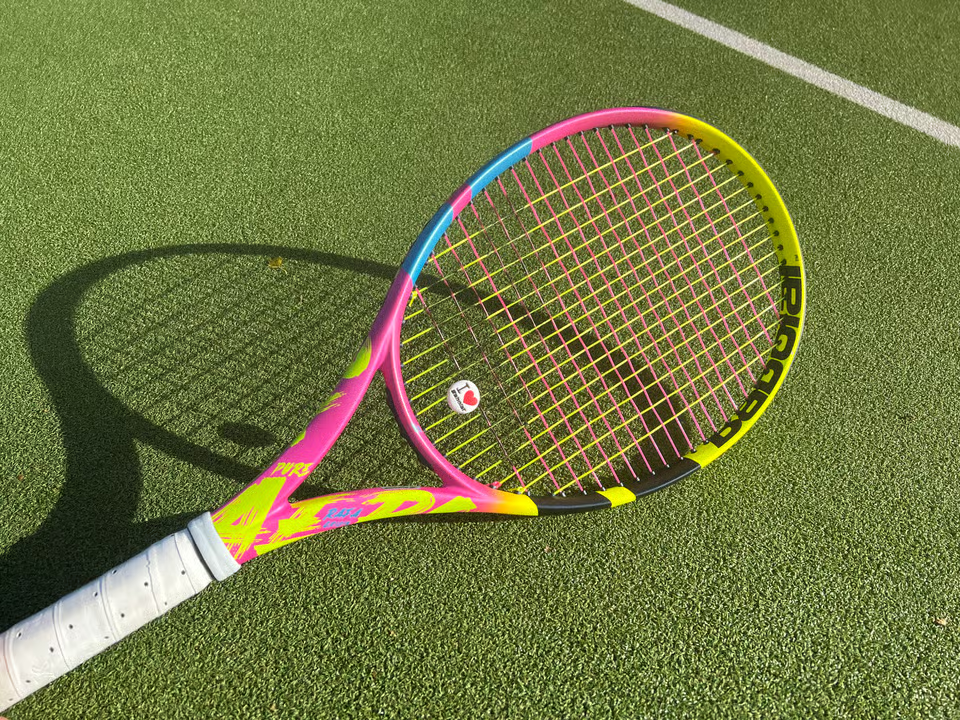
This article summarizes our frontier knowledge on how strings produce spin. It heavily relies on research available at Tennis Warehouse University. Further articles will be more speculative and include specific recommendations for how to design a stringbed for your own game. The importance of your exact stringbed increases as:
- ball speed rises
- racket head speed rises
- specifically, tangential racket head speed rises
Quickly, let’s establish our vocabulary:
- normal velocity/deflection – perpendicular to the plane of the stringbed
- tangential velocity/deflection – parallel to the plane of the stringbed
What We Know For Sure
The truth is, we still don’t really know what creates topspin. The strings, somehow, exert an upward force on the ball which acts behind its center of mass. This creates torque and thereby topspin. How exactly this force is created, and how to design a stringbed which produces more of it when you control for swing – we have a decent idea, but there are still specifics to iron out. However, we know a few things for sure.
1. Open stringbeds create more topspin
Even when you control for stringbed stiffness, the more open the stringbed, the more spin you will generate. This is probably because the ball deforms into those larger openings, giving the strings more leverage for producing torque up the back of it.

2. Lubricated stringbeds create more topspin.
Why? No one really knows, but it’s been measured convincingly. We used to think it was “snapback” – the process by which, before the ball is released from the stringbed, freely sliding strings snap back to their original position and apply torque, but recent high-speed footage has shown that much of the spin is imparted while the strings are still stretching.
It is probably some combination of:
- less energy lost to friction while sliding
- more sliding = larger apertures = more open string pattern
3. Softer = higher launch angle.
Softer stringbeds facilitate deeper pockets, which cause the tangential component of the swing to fling the ball up more, rather than just applying a torque which rotates it.
4. Eventually, too soft = less topspin.
Again, we’re not sure exactly why, but if you go too soft in an open stringbed, topspin production will actually collapse. My guess is that the ball pockets in so deeply that the main strings slide under it, close to its COM, and as a result the force vector tangential to the stringbed, which was supposed to act behind the COM, torquing the back of the ball up, now acts basically under the COM, launching it up instead of torquing it.
Inference, but Probably True
Counter-Spin Torque
As the ball pockets, it rolls onto the stringbed, pressing harder on the bottom than on the top. Due to this rolling action, the normal force vector out of the strings is actually below the ball’s center of mass, and so it produces a small amount of backspin torque.
This effect hasn’t been directly measured, but the TWU researchers inferred it from the data, and it’s a plausible mechanism. The result is that hitting harder in the back-to-front direction actually saps some of your topspin. The magnitude of this effect is unclear, but it is almost certainly greater the softer your stringbed and the deeper the pocket.
Pocketing and Stringbed Stiffness
When the ball hits the strings, it doesn’t just cause main-string sliding, it also causes normal deformation of both the main strings and the cross-strings. We call this deformation “the pocket”. The relative momentum of the ball and the racket, and the stringbed’s overall stiffness, combine to determine how deep or shallow the pocket is:
- Faster swings produce deeper pockets
- Slower swings produce shallower pockets
And with respect to the stringbed:
- A softer stringbed produces a deeper pocket
- A stiffer stringbed produces a shallower pocket
And while we’re here, we’ll mention the three primary attributes that determine a stringbed’s stiffness:
- the strings’ material stiffness (you can check TW compare tool)
- the strings’ tension (tighter = stiffer)
- how many strings is the ball hits during the collision (more strings = stiffer)
Stringbed Stiffness and Feel
Let’s consider the two extremes of stiffness:
- a slingshot (maximally soft)
- a 2×4 plank (maximally stiff)
Hitting with any stringbed feels like hitting somewhere between these two extremes. Even the stiffest beds do not truly feel as stiff as 2×4’s, and even the softest beds do not truly feel like using a slingshot, but each setup is somewhere along a continuum from 2×4 to slingshot, depending on how stiff it is.
The softer the stringbed, the more the ball’s exit velocity is coupled to the relative velocity of the racket and the ball.
The stiffer the stringbed, the more the ball’s exit velocity depends on the angle of the racket face at impact.
Players who like that feeling of “grabbing the ball and launching it” or “feeling the ball on the strings” will generally prefer softer stringbeds, stringbeds that behave closer to a slingshot than a 2×4 during pocketing. On the other hand, players who like “magic wand” feeling where they can make tiny little racket-face adjustments to place the ball exactly where they want will prefer stiffer stringbeds, where the ball is far more sensitive to the exact angle of the racket face at contact.
Control – Launch Variability
Control is best defined as the variance between launches produced by (effectively) the same exact swing. (Technically, on determinism, the exact same swing would produce the exact same result, but even in a laboratory setting, where they shot the ball at the string-bed the same way every time, launch behavior varied by 3-4 degrees between trials).
Softer stringbeds and deeper pockets lower control in this sense – they create larger variance from one impact to the next, even under the same impact conditions.
Control – Launch-to-Spin Ratio
Tangential velocity through contact always changes exit launch in two ways:
- The ball launches higher
- The ball has more topspin
The higher launch tends to make the ball land deeper, while the topspin tends to make the ball land shallower. So which effect wins? That depends on your equipment and swing speed. There are three options.
When you increase tangential velocity, while holding normal velocity constant:
1. The Ball Lands Shorter
When you’re playing under this condition, it’s extremely easy to control both the ball’s height over the net, and the depth at which it lands.
2. The Ball Lands at the Same Depth
In this window, depth control isn’t nearly as easy, but it’s also the window which gives you effortless access to deep balls. No matter how fast you swing vertically, your ball always ends up the same depth. Players mistake this feeling for control, but it is actually the opposite – a lack of depth control, disguised by the fact that you’re producing high-quality deep balls on every shot.
I suspect many players, when equipment testing, are tricked by this state, thinking it’s where they’ll play their best tennis. It is not. This is the window where, when any small aspect in the environment changes, your level will quickly collapse.
3. The Ball Lands Deeper
Here, you are out of the usable control window for the racket. Your options are:
- aim lower and hit the net a lot
- spray every ball
- lower normal racket head speed until you’re back in 1 or 2
Only the third is actually practical.
The Optimal (Topspin) Stringbed
Topspin itself is not a goal, but topspin does enable certain shot trajectories which are otherwise impossible. To produce those trajectories requires very high racket head speed, and a stringbed that is:
- open – large apertures for the ball to sink into between strings
- stiff – resulting in a shallower pocket
- elastic – providing high energy return in the normal and tangential direction
- sliding – for whatever reason, lubrication increases spin production
Further, those shots are only valuable if they can be controlled over the large-sample changing-environment that is a tennis match. Let’s look at how this problem has been solved over the last 20 years.
Two Decades of Data
Champ’s Choice
Most of the best tennis played over the last two decades was played on the following string beds.
Natural Gut 59 lbs x Luxilon ALU Power Rough 56 lbs, 97 sq inch 16×19 (Roger Federer)
Natural Gut 59 lbs x Luxilon ALU Power Rough 56 lbs, 95 sq inch 18×20, then 18×19 (Novak Djokovic)
Natural Gut 65 lbs x Luxilon 4g 65 lbs, 102 sq inch 18×19 (Serena Williams)
Natural Gut 67 lbs x Luxilon 4g 66 lbs, 104 sq inch 18×19 (Venus Williams)
Natural Gut 55 lbs x Luxilon ALU 55 lbs, 93 sq inch 16×19 (Marin Cilic)
This stringbed has won 77 majors. (Del Potro, Murray, Ash Barty, Zverev played gut in the cross. If you count those, you can bump that up to 84.)
These are topspin maximizing stringbeds, but they do maximize spin control within a smaller usable spin window.
The natural gut main string maximizes elastic return, improving both exit velocity and spin production at a given level of energy input. The Luxilon cross string is added to lubricate the string bed and stiffen it. These stringbeds are all relatively dense, but since the main string (gut) is soft, it slides out of the way during impact, opening the aperture larger, allowing sufficient spin production. Between the material stiffness of the Lux string, and the high tensions chosen for both strings, pocket depth is lowered enough that, even at high swing speeds, players maintain a spin-to-height ratio that allows depth control.
Tight, Stiff, Open Polyesters
1.35mm RPM Blast 55 lbs, 100 sq inch 16×19 (Rafael Nadal)
1.3mm 62 lb Head Hawk Touch, 100 sq inch 16×19 (Jannik Sinner)
1.30mm RPM Blast 55 lbs x 1.30mm RPM Team 53 lbs, 98 sq inch 16×20 (Carlos Alcaraz)
These stringbeds have won 34 majors.
Accept higher launch-to-launch variance, but gain ridiculous control over depth and height by doing so. Critically, these stringbeds must be stiff enough to produce shallow pockets, so that dramatically increasing tangential racket head speed still keeps you in window 1 or window 2, where depth control is possible.
Dense Full-Poly
1.30mm RPM Blast 57 lbs x 1.30mm RPM Blast 55 lbs, 95 sq inch 16×20 (Stan Wawrinka)
1.25mm RPM Power 55 lbs, 18×20 98 sq inch (Dominic Thiem)
1.25 mm Razor Code Soft 50 lbs 18×20, 95 sq inch (Daniil Medvedev)
These stringbeds have won 5 majors.
Stan Wawrinka swung so hard that he strung both extremely stiff and used quite a dense 16×20 Vcore 95 pattern. The impacts were likely violent enough that the strings sufficiently opened, which is how he still produced so much spin.
Thiem used a softer, thinner string, but at 18×20 98 sq inch, the stringbed was still extremely stiff.
Daniil Medvedev is the closest to “soft” of any major winner in the last two decades, but even he is playing an 18×20 pattern in a 95 sq inch frame.
Soft, Open Setups
These stringbeds have won 0 majors, and that’s not going to change.
A soft 1.25 mm poly, at 53 lbs, in a 98 sq inch 16×19, for example, does not provide the requisite level of spin-to-launch ratio to accelerate at the highest level. You could play like Mannarino, but you can’t play like Alcaraz or Federer.
A soft stringbed can, physically, produce the ball trajectories you see on tour, and occasionally it might even do so over a moderately large sample, but it is always flirting right on the edge of its spray window. If anything goes wrong, the player will lose control, and over the sample required to win a major, something will always go wrong.
September 14, 2026
Hello! Great article.
Does this mean that to find my right tension, I should start at a stiff level and work myself through to a tension that shows stable spin and depth control? I’ve tried playing with the Pro Staff RF97 true to spec of Federer both racket specs string setup and I produced zero spin.
I’ve just bought the Defyer 98 and 100, I’ve strung them with Head Multi main and Toroline Snap, tension 52-48(98), and 53-49(100), I’ve never played with Multifilament before. Unfortunately I was unable to play until 6 weeks after stringing, tension was around 44 on both. It felt comfortable, it wasn’t un controllable, but a hard to say, as it was a first try with this setup. I’m not sure if I’m going to continue with multifilament, but it does hold tension better for a recreational player without a stringing machine.
Thank you, and have a great day.
Best regards,
Edmund
October 24, 2026
Yes and no. Stiffness increases the peak forces of every impact, so if you start very stiff and work down, you can injure yourself at the beginning. Instead, use your current injury-free setup as a reference, and ask what you wish it did better.
That Defyer setup sounds great if you weren’t able to generate topspin with the RF 97 + gut. It’s a far more open string pattern, and the strings you described are much softer than the RF setup. Unless you’re playing in high humidity, I would personally recommend gut over multi. If you use 16g natural gut, it will last months, and it’ll play similarly in each of those months.
Currently, my favorite cross-string for gut is OToro-Tour. The tension maintenance helps it stay with the gut for longer. Based on your report there, I’d give you 16g gut at 50 lbs x 17g OToro-Tour at 46 lbs in the 100 Defyer as your go-to setup, and then tweak tension from there based on how it feels. If that felt to stiff, you could also switch to Caviar in the cross-string.
September 15, 2026
think you’re nailing all the details of what’s going on
w sjuper great explanations!!
bests
ep
September 17, 2026
Hi! I am interested in the gut free strings, because i love cows and want them to be healthy and happy 🙂